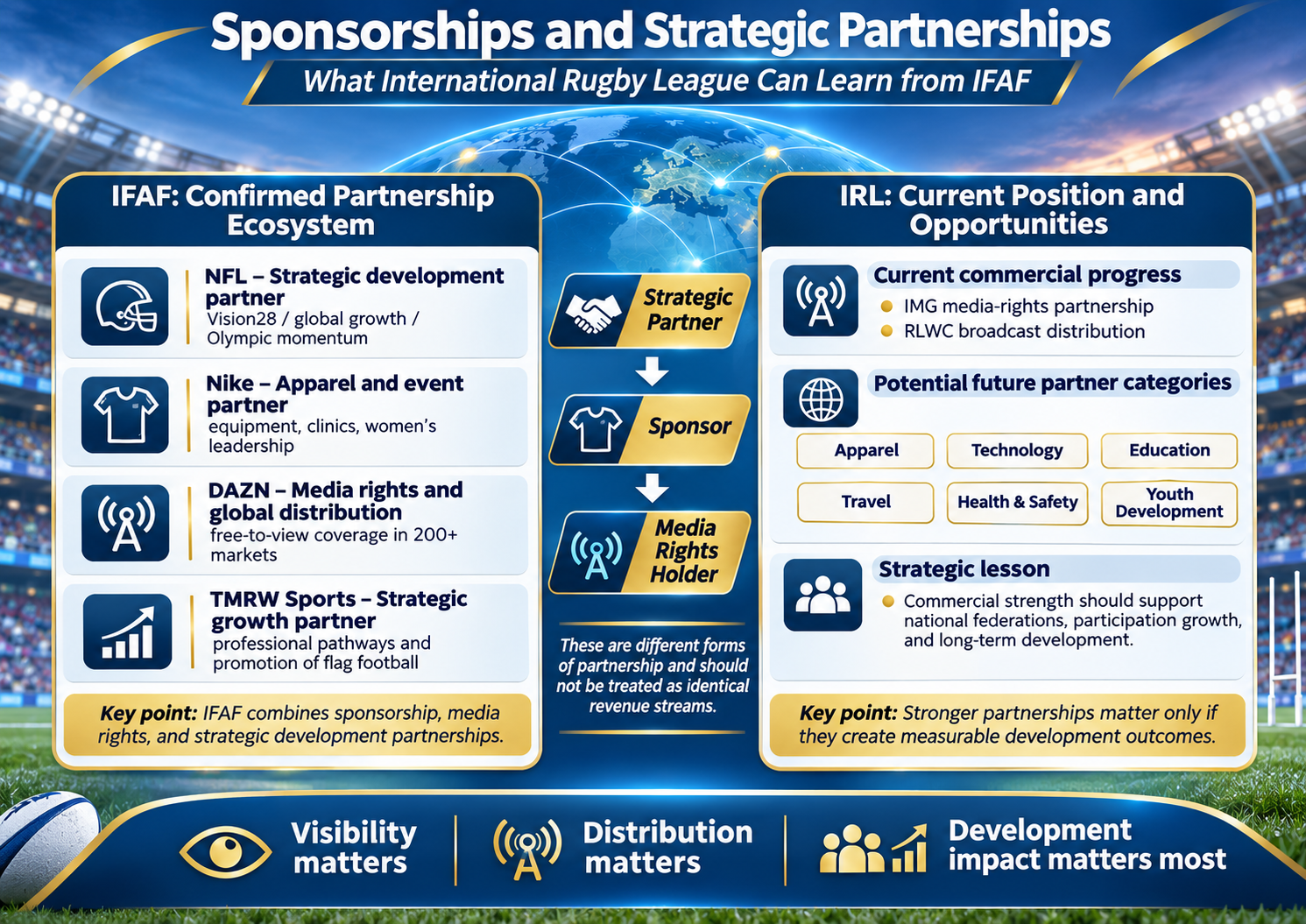
Original AI-generated conceptual illustration. All names and marks shown serve as editorial context; the image does not signify endorsement or an official institutional relationship.
Jovan Vujosevic
November 11, 2026
Abstract
This study examines whether International Rugby League (IRL) has developed a durable, diversified global sponsorship model comparable to those publicly documented by six other international sport federations: World Rugby, the International Handball Federation (IHF), the International Ice Hockey Federation (IIHF), World Lacrosse, the International Cricket Council (ICC), and the International Federation of American Football (IFAF). Documentary analysis combines IRL’s United Kingdom and Australian financial statements for 2024–2025, its published commercial strategy, and official announcements of corporate and media-rights partnerships available by November 11, 2026. The UK entity’s turnover rose from £187,844 to £544,331 in 2025 but it reported a £197,661 net loss and negative equity of £609,911. The Australian entity recorded A$33,775 in development grants in 2025, down from A$412,999 in the longer preceding comparative period. IRL has appointed IMG as a global media-rights partner and obtained partners for the 2026 World Cup; however, the publicly reviewed evidence did not establish an announced, long-term, federation-wide global corporate sponsorship comparable in disclosed scope and duration to selected peer arrangements. The analysis differentiates non-disclosure from proven absence and event sponsorship from sustained institutional partnership. It argues that a portfolio of recurring commercial relationships is necessary—but not sufficient—for systematic member-federation development, and recommends transparent sponsorship reporting tied to measurable domestic participation and governance outcomes.
Keywords: international rugby league, global sponsorship, financial sustainability, sports governance, development funding, resource dependence, commercial rights
Introduction
International sports federations are expected to organise international championships, maintain rules and eligibility systems, support members, build technical capacity, and expand participation. Financing these functions requires more than a periodic successful championship: it requires predictable income that can support development between major-event cycles. The commercialisation of international sport thus presents both an opportunity and a governance problem. Corporate relationships can provide cash, products, expertise, audiences, and distribution, but their terms, dependence risks, and contribution to development are not always visible in public accounts (Cornwell, 2008; Pfeffer & Salancik, 1978).
International Rugby League (IRL) provides an informative case. Its 2024 annual report described a strategic shift allowing the federation to contract global sponsors and broadcasters directly, rather than leaving the World Cup commercial inventory principally under local organising committee control (International Rugby League [IRL], 2025a). In November 2025 it appointed IMG as global media-rights partner for the 2026 Rugby League World Cup, and the 2026 tournament secured designated commercial partners (IRL, 2025b; National Rugby League [NRL], 2026). Yet these advances should not be mistaken automatically for an established federation-wide long-term global corporate sponsor.
The research problem is therefore a question of commercial architecture, rather than simply brand visibility: can IRL create recurring, independently sourced revenue that finances sustainable grassroots and institutional development across its membership? The central proposition evaluated here is that IRL lacks a publicly identifiable multi-year global corporate sponsor of the federation as a whole, of the kind documented in selected peer organisations. The proposition is treated as evidence-limited: absence of a named deal in the public source set cannot prove that no confidential commercial arrangement exists.
Research Questions
This paper addresses three questions: (1) What financial constraints and revenue concentration are visible in IRL’s 2024–2025 legal-entity accounts? (2) How do publicly documented, multi-year commercial partnerships at peer international federations differ in scope from IRL’s announced World Cup and media-rights relationships? (3) What commercial and reporting reforms would link global sponsorship more clearly to national-federation development?
Conceptual Framework
Resource Dependence and Diversification
Resource dependence theory holds that organisations rely on external actors for key inputs and face strategic constraints when supply is concentrated (Pfeffer & Salancik, 1978). In an international sports federation, dependence may arise from one mega-event, a handful of powerful member organisations, a principal broadcaster, or a small set of sponsors. Revenue diversification can reduce exposure to any single counterpart, although contracts with large sponsors introduce their own continuity, ethics, and reputational risks. Under this framework, the value of a global sponsor lies not simply in its public profile but in the predictability, scope, net financial benefit, and independence of the resources it supplies.
Sponsorship, Rights Agencies, and Event Inventory
Sponsorship grants a commercial entity an association with sport property in exchange for financial or in-kind consideration and associated rights. Research distinguishes the sponsor’s strategic objectives from the sport organisation’s ability to attract and sustain corporate support; media exposure and participation scale are relevant to sponsorship-seeking organisations (Berrett & Slack, 2001; Cornwell, 2008). A media-rights sales agency, by contrast, may represent the rights holder and negotiate distribution without itself becoming a sponsoring brand. A television licensee purchases or licenses coverage rights; a tournament sponsor may purchase only event-specific brand association; and a federation-wide sponsor may span competition cycles, the organisation’s institutional identity, and grassroots programmes. These categories should not be conflated.
Method
A qualitative comparative documentary study was combined with descriptive analysis of disclosed financial indicators. The primary IRL records were the unaudited financial statements of International Rugby League Limited in the United Kingdom, including 2024 comparatives, and the special-purpose financial report of Rugby League International Federation Limited in Australia for 2025, also including 2024 comparatives (International Rugby League Limited, 2026; Rugby League International Federation Limited, 2026). Official announcements and federation materials were reviewed for the six comparator bodies. The cut-off date for the partnership review was November 11, 2026.
Partnership evidence was coded on three dimensions: (a) type—corporate sponsorship, technical/product sponsorship, media-rights representation, broadcaster, or event-only partnership; (b) scope—federation-wide, multi-event, or single-tournament; and (c) duration—explicit expiry/multi-year term, documented decades-long continuity, or undisclosed. Where precise contract values were not published, no monetary value was imputed. Results therefore concern the public architecture and transparency of commercial relationships, not a ranking of sponsor revenue.
This analysis does not formally consolidate the two IRL companies. The entities have different functional currencies and reporting policies; intragroup loans and interest should not be aggregated as independent economic revenue. Peer organisations differ greatly in sport market, broadcasting footprint, Olympic status, legal structure, and reporting period, which limits causal inference from comparative examples.
Results
Financial Position of the United Kingdom IRL Entity
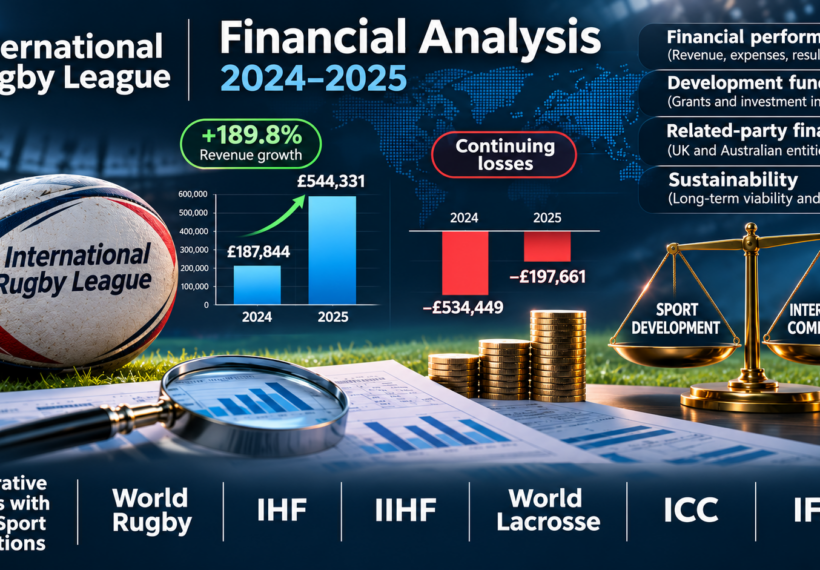
IRL UK turnover increased from £187,844 in 2024 to £544,331 in 2025, a nominal rise of 189.8%. The annual net loss narrowed from £534,449 to £197,661. Nevertheless, the year-end equity deficit deepened from £412,250 to £609,911, and the current ratio fell from approximately 0.98 to 0.71 (International Rugby League Limited, 2026). These are indicators of exposure rather than evidence that the organisation cannot continue operating: deferred income and loans from related parties are included in short-term liabilities.
Table 1
Key Indicators: IRL United Kingdom Entity, 2024–2025 (GBP)
| Indicator | 2024 | 2025 |
| Turnover | £187,844 | £544,331 |
| Administrative expenses | £798,264 | £724,802 |
| Net profit/(loss) | −£534,449 | −£197,661 |
| Year-end cash | £802,655 | £778,382 |
| Current assets | £1,218,971 | £1,521,725 |
| Current liabilities | £1,243,956 | £2,131,705 |
| Year-end equity | −£412,250 | −£609,911 |
| Current ratio | 0.98 | 0.71 |
Note. Source: International Rugby League Limited (2026), pp. 3–4. The current ratio is author-calculated. The UK accounts were unaudited.
The UK report provides an additional indicator of revenue concentration. Related-party sales of £387,768 to the Rugby Football League, £101,499 to the Australian Rugby League Commission, and £54,859 to New Zealand Rugby League totalled £544,126—about 99.96% of £544,331 turnover. This concentration is an accounting observation, not proof that IRL had no commercially originated or contracted sponsorship revenue elsewhere. In particular, the 2026 World Cup commercial cycle followed the reporting year, and the ultimate recognition of certain receipts may occur in other entities or periods (International Rugby League Limited, 2026, p. 13).
Australian Entity: Development Grants and Related-Party Interest
The Australian Rugby League International Federation Limited reported A$165,612 in 2025 revenue. Its notes identify this amount as interest charged on the loan to the UK entity; it is therefore not evidence of independent external sponsorship income. Development grants fell from A$412,999 in the earlier comparative period to A$33,775 in 2025, a nominal reduction of 91.8%. The earlier 2024 period covered 14 months versus 12 months in 2025, and monthly normalisation still indicates a decline of about 90.5%. The company reported A$96,584 profit in 2025 compared with a A$167,761 loss previously. Its £-denominated borrowing relationship is recorded in the UK accounts, while the corresponding Australian receivable totalled A$2,401,175 at the end of 2025 (Rugby League International Federation Limited, 2026).
Table 2
Key Indicators: RLIF Australian Entity, 2024–2025 (AUD)
| Indicator | 2024 (14 months) | 2025 (12 months) |
| Revenue: intercompany interest | A$194,732 | A$165,612 |
| Development grants | A$412,999 | A$33,775 |
| Total expenditure | A$418,090 | A$36,834 |
| Net profit/(loss) | −A$167,761 | +A$96,584 |
| Year-end cash | A$14,991 | A$16,641 |
| Loan receivable from UK entity | A$2,270,875 | A$2,401,175 |
| Year-end equity | A$2,556,752 | A$2,653,336 |
Note. Source: Rugby League International Federation Limited (2026), pp. 2–4. The different comparative period lengths limit straightforward annual comparison. The figures do not measure total development expenditure by all IRL-related bodies.
The reduction in grants raises a legitimate policy question but not a definitive accounting conclusion about overall spending on development. The UK entity or partner federations may finance technical education, governance programmes, and other services outside the Australian grant line. Indeed, IRL’s 2025 annual report announcement points to international technical education activities and stronger support for emerging national bodies (IRL, 2026a). A full assessment requires a group-wide schedule of development expenditure and outcomes by region.
The Missing Federation-Wide Global Corporate Sponsorship Benchmark
IRL’s own 2024 management report is unusually informative. It states that the post-2023 commercial strategy would allow the federation to acquire global sponsors and broadcasters directly for the first time, and would create conditions for longer-term investment (IRL, 2025b). This statement indicates a transition in the governing body’s commercial model. In 2025, IRL announced IMG as its exclusive global media-rights partner for the 2026 World Cup, with scope for extension to future events; IRL also stated that IMG’s remit includes media valuation, market strategy, and negotiations (IRL, 2025b). This is meaningful commercial progress, but IMG is a sales and strategic services counterparty, not identified in the announcement as a cash-paying brand sponsor of the federation.
In July 2026 the World Cup organiser announced tournament partners including Youi, Bank South Pacific, Rebel, Steeden, Ticketmaster, and New Balance (NRL, 2026). These companies should be credited as genuine commercial partners of RLWC2026, but their publicly announced categories concern the event, and the source does not establish a continuing multi-cycle relationship sponsoring IRL’s governance, development portfolio, or full international competition calendar. Similarly, IRL’s October 2026 worldwide broadcast arrangements evidence improved distribution, not necessarily federation-wide corporate sponsorship (IRL, 2026b).
Across the reviewed official announcements and accounts, this study did not identify a named, long-term, federation-wide global corporate sponsor with a disclosed multi-year term and institutional scope comparable to Emirates–World Rugby or Nike Lacrosse–World Lacrosse. Accordingly, the defensible conclusion is an observable public sponsorship gap, not an assertion that the IRL has no global commercial partners whatsoever or that a private agreement cannot exist.
Comparator Partnerships
Table 3
Documented Sponsorship and Commercial Partnerships in Seven Federations
| Federation | Named arrangement | Documented scope and term | Classification |
| IRL | IMG; RLWC2026 event partners | IMG rights representation for RLWC2026, possible future expansion; event partners announced for 2026 | Media agency + event partners; no verified federation-wide multi-year sponsor |
| World Rugby | Emirates | Platinum/Principal Partner of World Rugby through 2035, spanning multiple Rugby World Cups | Long-term federation-level corporate partner |
| IHF | hummel; Molten; Gerflor | Long-term IHF technical partners; historic renewals to 2027 | Multi-year federation technical sponsors |
| IIHF | Škoda | World Championship main sponsor continuously since 1993 | Long-running event sponsor; not necessarily federation-wide |
| World Lacrosse | Nike Lacrosse | Global footwear and apparel partner through 2028 | Multi-year federation global partner |
| ICC | Hyundai | Multi-year ICC Premier Partner, worldwide rights across ICC event calendar | Multi-year cross-event global corporate partner |
| IFAF | Nike; DAZN | Nike global flag-football partnership through LA28; DAZN multi-year global rights carriage | Sport-development corporate partner + broadcaster |
Note. Sources: ASOIF (2026); DAZN (2026); Emirates (2025); ICC (2025); IHF (n.d.); IRL (2025b, 2026b); NRL (2026); Škoda Auto (2026); World Lacrosse (2024). An identified corporate partnership is not necessarily cash sponsorship: in-kind and rights-service contributions may be material. No row claims undisclosed financial amounts.
World Rugby: A Federation-Level Relationship Across Competition Cycles
In November 2025, Emirates renewed its World Rugby relationship as Platinum and Principal Partner through 2035. The agreement explicitly extends across multiple men’s and women’s Rugby World Cups and qualifying rounds. The point of comparison is not that rugby league should reproduce the scale of rugby union; it is that World Rugby publicly identifies the relationship as a partnership with the federation over a defined decade, rather than a single one-off tournament. This creates a potentially more stable platform for brand activation, sales planning, and long-horizon negotiations (Emirates, 2025). The private contract value is not specified in the source and cannot be imputed.
IHF and IIHF: Distinguishing Technical Partnership From Event Sponsorship
IHF maintains an official partner programme recognising Gerflor, hummel, and Molten, among others, and refers to the businesses as long-term partners. Its own activity report describes multi-year extensions of key equipment and flooring relationships, including agreements running to 2027 (International Handball Federation [IHF], n.d., 2024). In these categories, value may consist of supplying equipment, sponsorship rights, financial contributions, or a mixture. This is an institutional platform even though the financial worth of each deal is not disclosed.
For IIHF, Škoda has been the official main sponsor of the IIHF Ice Hockey World Championship since 1993, marking 33 consecutive years in 2026 (Škoda Auto, 2026). The duration demonstrates remarkable commercial continuity but the agreement is expressly described as championship sponsorship; it would be misleading to label it automatically a federation-wide sponsor. This is an important counterexample against simplistic rankings based solely on the presence of a well-known brand.
World Lacrosse and IFAF: Potentially More Relevant Growth Models
World Lacrosse designated Nike Lacrosse its Global Footwear and Apparel Partner through 2028. The rights extend across multiple championships and its federation brand. The arrangement illustrates how a smaller international sport can package its competition portfolio and institutional identity into a multi-year global proposition without requiring the commercial scale of rugby union or cricket (World Lacrosse, 2024). It also announced other multi-year specialised suppliers, including Gilman Gear through 2028 (World Lacrosse, 2026).
IFAF entered a multi-year global partnership with Nike in August 2026, covering technical apparel, competitions, women’s leadership and sport-development clinics in three continents. This is particularly relevant because the partnership explicitly integrates grassroots access and development objectives rather than focusing solely on championship imagery (Association of Summer Olympic International Federations [ASOIF], 2026). Its separate multi-year deal with DAZN is a global broadcast arrangement, not a corporate sponsorship agreement; both together show a layered commercial strategy (DAZN, 2026).
ICC: Commercial Rights Inventory Across Multiple Events
ICC announced Hyundai as a multi-year Premier Partner in December 2025, with exclusive rights spanning its international events calendar. The ICC announcement described a structured portfolio of commercial tiers including other global brands (International Cricket Council [ICC], 2025). The economic scale of cricket makes the ICC a weak direct budgetary benchmark for IRL, but its marketing structure offers a useful conceptual comparison: a sponsor proposition can extend across a governed portfolio of events rather than one host-organised tournament.
Discussion
From Event Monetisation to Recurring Institutional Sponsorship
Three findings emerge. First, IRL has made documented progress toward controlling and selling international rights. This should be recognised rather than dismissed. Second, the public evidence reviewed does not establish a named multi-cycle global corporate sponsor whose contractual reach clearly includes the international federation and its development programme. Third, the financial reports show why closing the gap matters: the UK entity reported negative equity, related-party income concentration, and sensitivity to future tournament rights, while the Australian entity’s grant-making was modest in 2025. None of these indicators proves that a sponsorship deal would resolve all structural problems, but collectively they strengthen the case for diversifying sustainable external revenues.
A commercial rights agency can help identify sponsors and broadcasters, but appointing the agency does not establish the success of its mandate. Likewise, World Cup event partners create real commercial value, yet the public terms do not disclose whether IRL will retain a material share after tournament expenditure or whether sponsors will support the sport in non-World-Cup years. The distinction is analytically central: a development federation needs not only products and visibility at marquee events, but resources and institutional relationships that can be mobilised in developing nations on a repeatable basis.
Why the Direct Grant Figure Matters – And What It Cannot Prove
In 2025, the Australian RLIF recorded A$33,775 of development grants. Set against the ambitions of a global federation, that is a small identifiable cash-grant channel. Even without dividing it equally across countries, it raises concerns about how grants at that scale could substantially support pitches, refereeing, medical safety, domestic championships, youth programmes, and technical personnel across multiple regions. However, it is not the federation’s audited consolidated development budget and should not be presented as the whole amount spent globally. Some capacity-building may be funded directly through the UK company or delivered in kind by members and partners (IRL, 2026a; Rugby League International Federation Limited, 2026).
A further question is whether global rights proceeds are earmarked for member development or predominantly needed to finance the governing body and elite-event administration. Without separating sponsorship cash receipts, media rights revenue, event fees, personnel costs, grants, and in-kind assistance, the membership cannot readily evaluate commercial strategy against developmental outcomes. More transparent segment reporting would reduce this ambiguity.
Sponsorship as a Development Mechanism
If its long-term relationships are properly structured, IRL could attract several distinct categories of sponsor: an institutional principal partner spanning the full IRL calendar; a technology, data or education partner supplying a coaching and refereeing platform; an equipment partner supporting new national leagues; a safeguarding/medical partner; and geographically targeted partners for Africa, the Americas, Asia-Pacific and Europe. These are proposed categories rather than deals already secured. Each relationship should include measurable, independent benefits for the sponsor and public benefit for member federations, including minimum annual commitments, performance reporting and appropriate integrity safeguards.
A credible development-linked sponsorship programme should monitor the percentage of sponsorship receipts not restricted to a single World Cup, the share of corporate contributions that is cash rather than in kind, the percentage deployed to member development, renewal rates, and domestic performance indicators such as active clubs, competitions, certified coaches, trained match officials, and participation by women and young people. Such measures would distinguish global exposure from measurable growth of the sport.
Recommendations
First, IRL should publish a sponsorship inventory with separate classifications for federation-wide corporate sponsors, tournament sponsors, technical suppliers, global media-rights advisers, broadcasters and public-sector funders. Each entry should state the public contractual duration, geographic territory, rights covered and, where confidentiality permits, aggregate revenue by category. Second, the federation should set a multi-cycle commercial plan extending beyond the 2026 and 2030 World Cups, with minimum revenue diversification objectives and renewal milestones. Third, development budgets should be reported alongside finance statements in an IRL-wide schedule explaining intragroup transactions and grant funding at both legal entities. Fourth, a predetermined share of unrestricted external commercial revenue should be allocated to a protected member-development programme, subject to financial feasibility and board approval. Fifth, rights partnerships should be assessed not just by reach and audience numbers but by the actual incremental resources available for federation programmes. Finally, annual reports should publish a regional outcomes scorecard that links commercial income to tangible domestic sport activity.
Limitations
The study is based on publicly announced agreements and the financial reports supplied for 2024–2025. Sponsor contract values, margins, internal rights-fee allocations, confidentiality clauses and possible unpublished agreements were unavailable. No causal relationship between the absence of a publicly announced federation-wide sponsor and the financial results can be demonstrated from the evidence. The IRL UK accounts are unaudited, and the Australian accounts are prepared as special-purpose financial statements. Furthermore, a 2026 World Cup sponsorship deal may generate revenue in an accounting period after 2025; this study therefore does not estimate 2026 performance. Comparators differ significantly in market size, Olympic access, rights ownership and event calendars.
Conclusion
By November 11, 2026, International Rugby League had taken identifiable steps toward stronger commercial control: an IMG media-rights arrangement, broader World Cup broadcast distribution, and partners for RLWC2026. Nonetheless, the available public record did not verify an explicitly multi-year, federation-wide global corporate sponsor with the institutional breadth or disclosed duration of selected arrangements at World Rugby, IHF, World Lacrosse, ICC, or IFAF. It is therefore defensible to describe a public long-term global sponsorship gap, but not to claim categorically that IRL has no global partner or that no undisclosed sponsor agreement exists. The IIHF example further demonstrates that multi-decade event sponsorship is not necessarily identical to federation sponsorship.
The financial context makes this distinction consequential. IRL UK reported a £197,661 loss and negative equity of £609,911 in 2025, while the Australian entity recorded A$33,775 in development grants. Although the latter is not a complete measure of worldwide IRL spending, it raises an unavoidable governance question: how does the federation intend to finance global participation, domestic competitions and national institutional capacity on a stable basis if independent, recurring commercial support remains insufficiently established or insufficiently disclosed? The answer cannot rely solely on staging successive World Cups or achieving broader television reach. A sustainable international federation should translate commercial opportunities into regular support for national governing bodies and measurable growth of the sport in their own countries.
The immediate strategic challenge is not to imitate the income of cricket or rugby union, but to build a proportionate portfolio of durable commercial relationships, publicly explain how these differ from event deals, and demonstrate what members receive. Global sponsorship should become a means of financing sport development—not merely a commercial label attached to an international tournament.
References
Association of Summer Olympic International Federations. (2026, August 5). IFAF and Nike seal multi-year, worldwide flag football partnership. https://www.asoif.com/news/ifaf-and-nike-seal-multi-year-worldwide-flag-football-partnership
Berrett, T., & Slack, T. (2001). A framework for the analysis of strategic approaches employed by non-profit sport organisations in seeking corporate sponsorship. Sport Management Review, 4(1), 21–45. https://doi.org/10.1016/S1441-3523(01)70068-X
Cornwell, T. B. (2008). State of art and science in sponsorship-linked marketing. Journal of Advertising, 37(3), 41–55. https://doi.org/10.2753/JOA0091-3367370304
DAZN Group. (2026, May 21). DAZN to broadcast International Federation of American Football competitions globally, for free. https://dazngroup.com/press-room/dazn-to-broadcast-international-federation-of-american-football-competitions-globally-for-free/
Emirates. (2025, November 27). Emirates and World Rugby commit to new decade together, cementing one of rugby’s longest-running partnerships. https://www.emirates.com/media-centre/emirates-and-world-rugby-commit-to-new-decade-together-cementing-one-of-rugbys-longest-running-partnerships/
International Cricket Council. (2025, December 23). ICC signs top tier, multi-year global partnership with Hyundai. https://www.icc-cricket.com/media-releases/icc-signs-top-tier-multi-year-global-partnership-with-hyundai
International Handball Federation. (n.d.). Marketing: Official IHF partners. Retrieved November 11, 2026, from https://www.ihf.info/marketing/
International Handball Federation. (2024). IHF activity report 2021–2023 [Marketing: Partners and sponsors, pp. 60–61]. https://www.ihf.info/sites/default/files/2024-01/Agenda%20item%208_E.pdf
International Rugby League. (2025a). Annual report 2024 [Management report, p. 11]. https://www.intrl.sport/uploads/docs/IRL_AnnualReport_2024.pdf
International Rugby League. (2025b, November 13). International Rugby League appoints IMG as global media rights partner for RLWC26. https://www.internationalrugbyleague.com/article/614/international-rugby-league-appoints-img-as-global-media-rights-partner-for-rlwc26
International Rugby League. (2026a, March 13). IRL publishes 2025 annual report. https://www.internationalrugbyleague.com/article/686/irl-publishes-2025-annual-report
International Rugby League. (2026b, October 13). IRL RLWC 2026 adds broadcast partners to complete global coverage. https://www.internationalrugbyleague.com/article/869/irl-rlwc-2026-adds-broadcast-partners-to-complete-global-coverage
International Rugby League Limited. (2026). Directors’ report and financial statements for the year ended 31 December 2025 [Unaudited report, with 2024 comparative data]. Companies House. https://find-and-update.company-information.service.gov.uk/company/10274920/filing-history
National Rugby League. (2026, July 7). RLWC2026: 100 days to go to Rugby League World Cup 2026 kick-off. https://www.nrl.com/news/2026/07/07/rugby-league-world-cup-2026-100-days-to-go/
Pfeffer, J., & Salancik, G. R. (1978). The external control of organizations: A resource dependence perspective. Harper & Row.
Rugby League International Federation Limited. (2026). Financial report for the year ended 31 December 2025 [Special-purpose financial report with 2024 comparative data; supplied document].
Škoda Auto. (2026, May 14). Škoda Auto celebrates 33 years as official main sponsor of the IIHF Ice Hockey World Championship and unveils the Epiq. https://www.skoda-storyboard.com/en/press-releases/skoda-auto-celebrates-33-years-as-official-main-sponsor-of-the-iihf-ice-hockey-world-championship-and-unveils-the-epiq/
World Lacrosse. (2024, July 23). World Lacrosse signs exclusive multi-year global partnership with Nike Lacrosse. https://worldlacrosse.sport/world-lacrosse-signs-exclusive-multi-year-global-partnership-with-nike-lacrosse/
World Lacrosse. (2026, May 6). Gilman named official goal of World Lacrosse through 2028. https://worldlacrosse.sport/gilman-named-official-goal-of-world-lacrosse-through-2028/